We help each other learn

Our agreement: how we work together at START A BIT, one part of our approach. Everyone needs room to think, try and build. These few rules help us take care of each other and of the things we use. They are for students and adults, in our lessons and on our website.

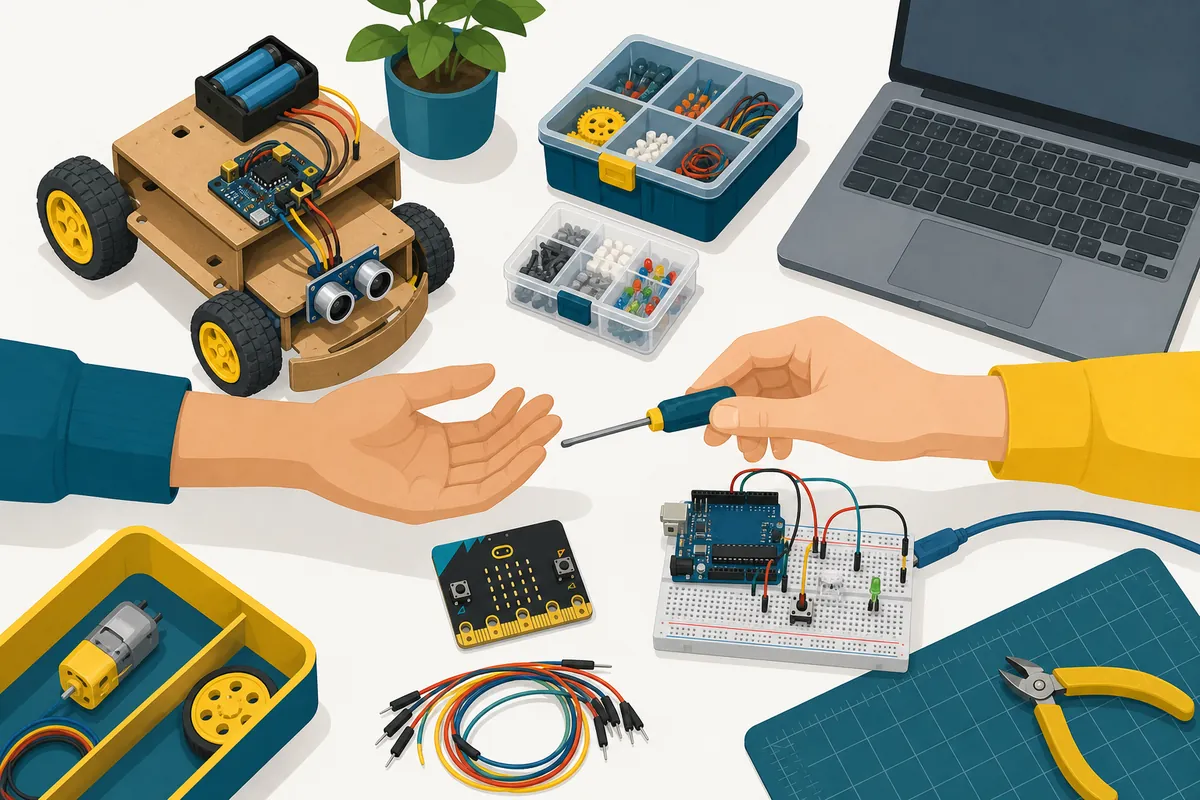
A shared maker table: a cardboard robot car, a Micro:bit, an Arduino on a breadboard, part boxes, and two hands passing a screwdriver

Three big ideas

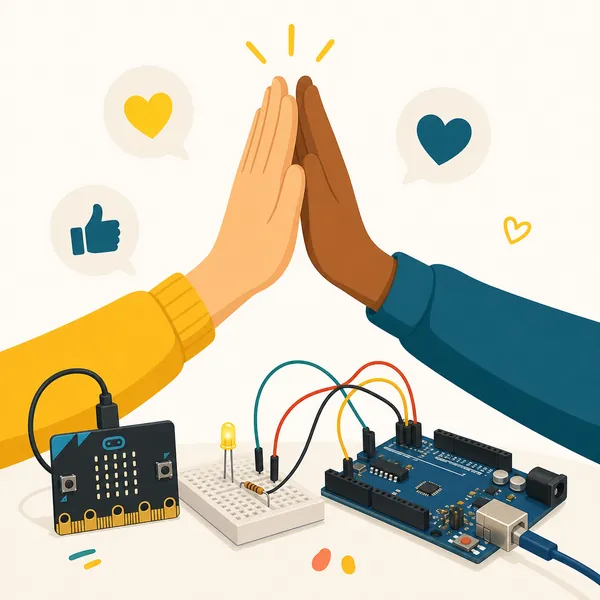
Two hands giving a high five above a breadboard with a glowing LED

We are kind

Everyone feels welcome and can work.

  • We listen when someone else is speaking.
  • We use friendly words, in the room and in messages on the website. Rude or hateful words are not welcome, and the website does not send them.
  • We help when someone is stuck, and we say whose idea or code we used.
  • We keep our voice at the right level (see below), so others can think.
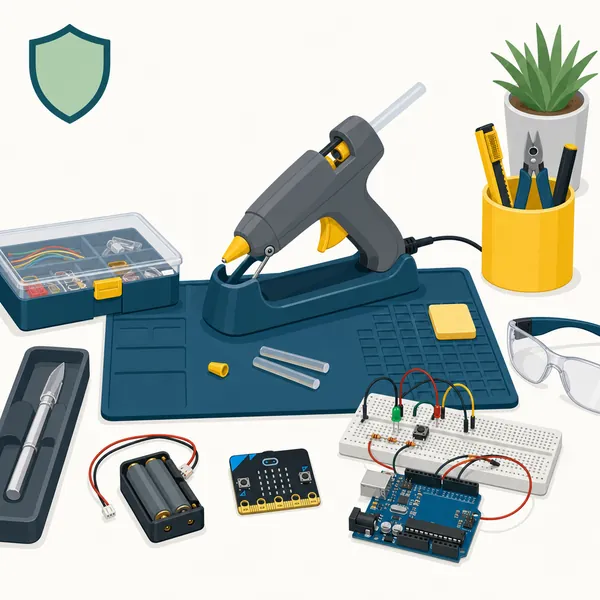
A neat workbench: a hot glue gun on its stand, a craft knife in a tray, a small battery pack and a Micro:bit

We work safely

Our electronics run on low voltage. Some tools need care.

  • We use hot glue guns and craft knives only together with the teacher.
  • We power projects only from batteries or USB, never from the wall socket (see below).
  • We tell the teacher at once when something gets hot or smells. That is never trouble.
  • Online too: our sign-in pictures are ours alone, and the website shows work and hands, never a face without the family's permission.
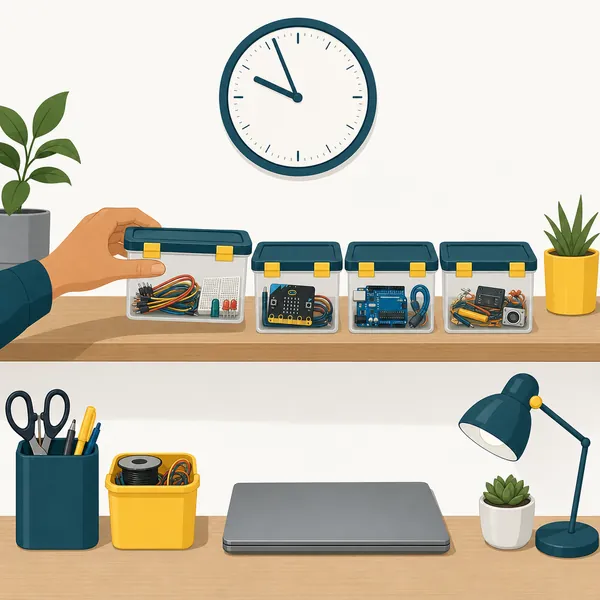
A wall clock before ten, a hand putting a part box back on its shelf, a closed laptop

We take care

Of our time, our things and our group.

  • We come on time, and tell the teacher before a lesson when we cannot come.
  • We bring our laptop, charged, and use it (and AI) for the project, as the teacher agrees with each of us.
  • We clean up and leave the room as we found it: parts back in their boxes, tables clear.
  • We tell the teacher in time when we find something broken or damaged, ours or the room's. Telling is always right, even after an accident.

Inclusion: everyone belongs, we explain, we do not show off

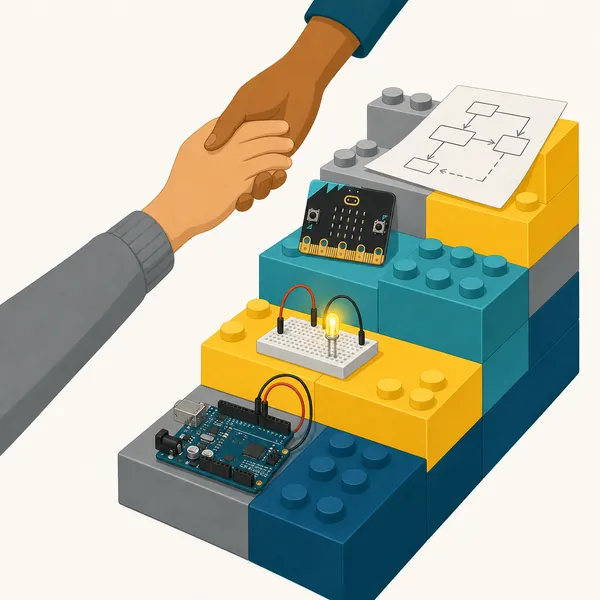
One hand helps another up a staircase of building blocks; on the steps a Micro:bit, a breadboard and a sketch

Knowing a lot is great. But when some show off, others stop asking, and some stop coming. Inclusion is everyone's job: we make room for each other, so everyone feels they belong. Real engineers, even after twenty years, still learn every day, from people of every age.

  • We include everyone: girls and boys, younger and older, new and experienced, quiet and loud, every language and background. Different people make better teams.
  • Everyone is learning here, the teacher too. "I don't know yet" and "I was wrong" are good things to say.
  • We use plain words. When you use a technical word, explain it, so everyone can follow. A word others do not understand shuts them out.
  • No "What? You don't know that?" Acting surprised makes people stop asking, and asking is how we learn.
  • We ask before we take over. Offer help; if they say yes, help them find the answer. We never pull out someone's wires or change their code without asking.
  • We take turns. In a pair, one builds and one guides, then we swap. Everyone gets to speak and to try, the quiet ones too: we ask them what they think.
  • We correct kindly, and only when it matters for the work.
  • We build so others can follow: tidy wiring, clear names, short comments. We hand in only what we can explain.
  • Using what you know to make someone feel small is bullying. Tell the teacher: it stops here.
Why: what research, engineering teams and the law say
  • In Swedish schools it is the law. The Education Act (skollagen, chapter 6) forbids degrading treatment (kränkande behandling) and requires schools to work actively against it, and the Discrimination Act requires active measures against discrimination and harassment (Skolverket).
  • At work too. Employers must make clear that victimisation (kränkande särbehandling) is not accepted, and have routines to handle it (Arbetsmiljöverket, AFS 2023:2). The Discrimination Act (diskrimineringslagen) protects against discrimination for sex, transgender identity or expression, ethnicity, religion or other belief, disability, sexual orientation and age (Equality Ombudsman). What we practise here is what our students will meet at work.
  • Students who wonder whether "people like me" belong in a subject read every setback as proof, and give up more often: belonging uncertainty (Walton and Cohen, 2007). Feeling left out by others makes it grow (Höhne and Zander, 2019), and a feeling of belonging goes with staying in science and technology (Lewis and others, 2017).
  • Teams learn when everyone dares to ask and to admit a mistake: psychological safety (Edmondson, 1999). Google's study of 180 teams found it the most important thing for a team that works well (Project Aristotle, 2016).
  • Students who accept what they do not know yet try harder after a failure: intellectual humility (Porter and others, 2020).
  • Words people do not understand make them feel they do not belong in science (Shulman and others, 2020).
  • Programmers have said it for fifty years: egoless programming. You are not your code; review the work, not the person (Weinberg, 1971).
  • A well-known school for programmers, the Recurse Center, has four social rules: no feigning surprise, no "well, actually" corrections, no backseat driving, and no subtle prejudice.

Electricity: safe here, dangerous at home

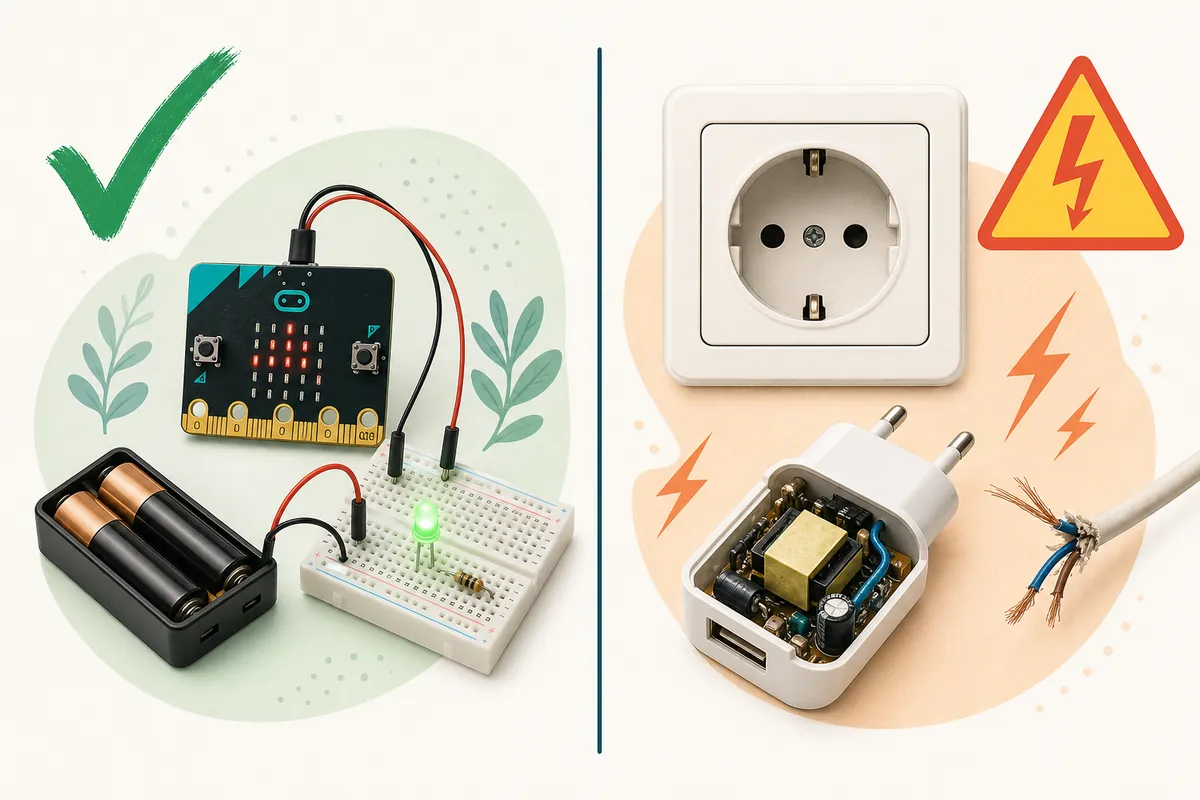
Left: a Micro:bit with a battery pack and a glowing LED, safe. Right: a wall socket, an opened charger and a broken cable with a lightning warning, dangerous

Here: low voltage

Our boards run on batteries or a USB cable: 3 to 5 volts. You can touch the wires and parts safely. Still, we never connect the two ends of a battery directly: it gets hot.

At home: 230 volts

The wall socket, and everything that plugs into it, has enough power to hurt or kill. Never open a charger, a socket, a lamp or any device that plugs into the wall, never touch a broken cable, and never connect a project to the wall socket. Ask an adult who knows.

Our voice levels

A building room needs some talk, but not too much. The teacher can show a number; 1 is right for most of the lesson.

0ListenSomeone explains or shows something to everyone.
1Table talkOnly the people next to you hear you. Most of the lesson.
2To the roomYou show your project, or ask everyone a question.
3WarningOnly to warn about danger, like something hot falling.

Can I bring a friend?

Friends are welcome. But only registered students, and guests who booked an open day, take part in a lesson: it is planned for them (places, parts, help and safety). So we ask first, and a friend starts at an open day. A guest who comes without the teacher's yes cannot join the lesson.

If something goes wrong

Everyone makes mistakes, adults too. We fix things together, in three calm steps.

  1. A reminder. The teacher reminds us of the agreement and what needs to change.
  2. A short talk. If it goes on, the teacher talks quietly with the student and listens. Together they agree what to do next.
  3. A talk with the parents. If more help is needed, the teacher, the student and the parents make a plan so lessons work well for everyone.

If you feel unsafe, or someone is unkind to you, tell the teacher at once. You do not need to wait.

A five-minute quiz

Short questions from real situations: bringing a friend, plain words instead of show-off words, code others can read, broken parts, electricity at home. In a lesson the teacher shows it on the big screen and everyone answers on their phone. On your own, try a round any time. Now and then, one of these questions also comes up in the other quizzes.

Quiz together on the big screen Try it on your own

For parents and families

Please help your child come and be picked up on time, and tell us before a lesson when your child cannot come. Please never bring another child to a lesson without agreeing it with the teacher first: a child who is not registered cannot take part. Share anything we should know to keep your child safe. Please read this agreement together with your child: registering for START A BIT means that you and your child agree to it. Questions are always welcome on the Contact page.